A larger FFT separates close frequencies; a smaller FFT places fast events more accurately in time.
What FFT size controls
An FFT divides a short block of audio into frequency bins. FFT size is the number of samples in that block. At a 48 kHz sample rate, a 4096-sample window spans about 85 milliseconds. The analyzer returns half as many usable bins because frequencies above the Nyquist limit are not represented separately.
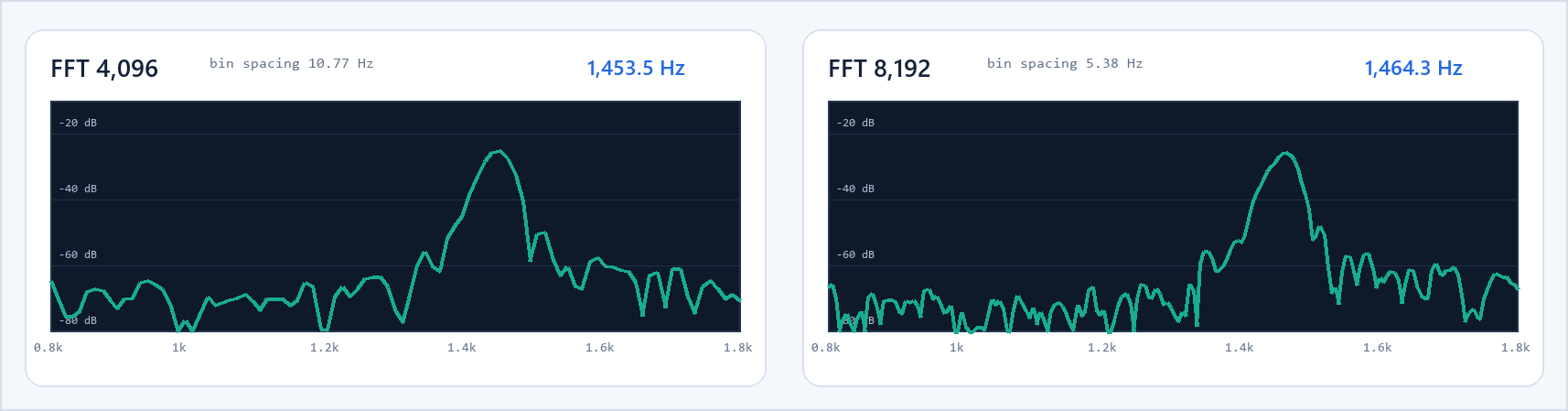
Approximate bin spacing is sample rate divided by FFT size. At 48 kHz, 2048 gives 23.4 Hz per bin, 4096 gives 11.7 Hz, and 8192 gives 5.9 Hz. Finer bins help separate close steady tones.
The unavoidable tradeoff
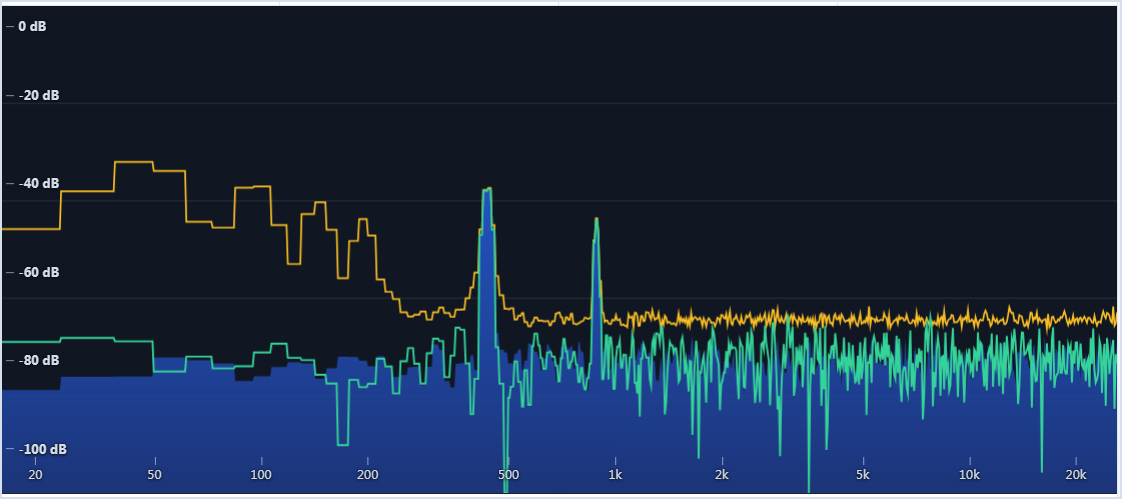
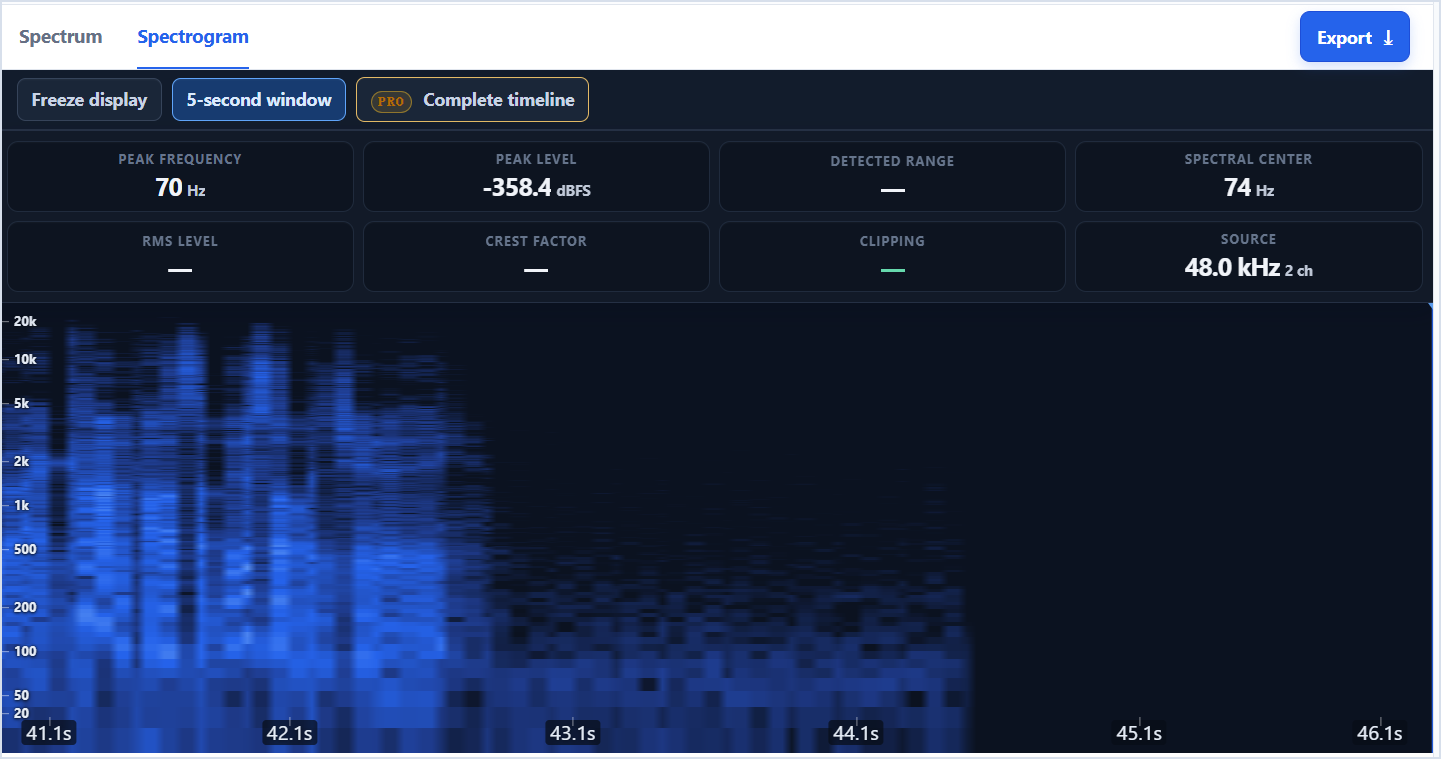
More samples require more time. A large FFT can distinguish 440 Hz from a nearby tone, but a drum hit may smear across several spectrogram columns. A small FFT places the hit more accurately in time, but its frequency energy spreads across wider bins.
This is not a software limitation that can be switched off. It follows from analyzing a finite time window. Choose the resolution that fits the event you care about.
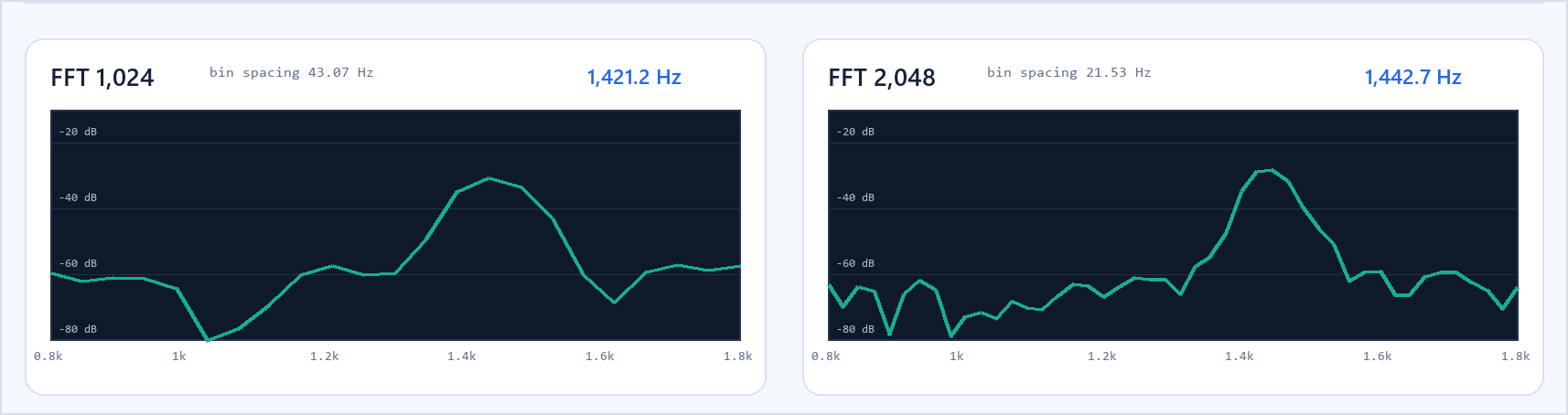
- 1024: fast transients and coarse overview.
- 2048: speech, percussion, and responsive live input.
- 4096: balanced default for mixed material.
- 8192: sustained notes, hum, and close harmonic detail.
FFT size does not create accuracy by itself
A larger number of bins cannot rescue a noisy recording, a drifting source, or an insufficient sample rate. The apparent peak can also sit between bins. Window functions and interpolation influence the displayed peak, while room reflections and modulation can broaden it naturally.
Use stable source material, inspect more than one frame, and report a sensible number of decimal places. A browser readout with many digits is not automatically a measurement with equal real-world certainty.
A practical selection method
Start at 4096. If two steady peaks merge, increase the FFT size. If clicks, consonants, or drum attacks look stretched, decrease it. For spectrogram art, compare 4096 and 8192 because edge clarity depends on how the image was encoded.
Keep the setting fixed when comparing recordings. Otherwise, a change in line thickness or peak height may come from the analysis window rather than the source.
- 01
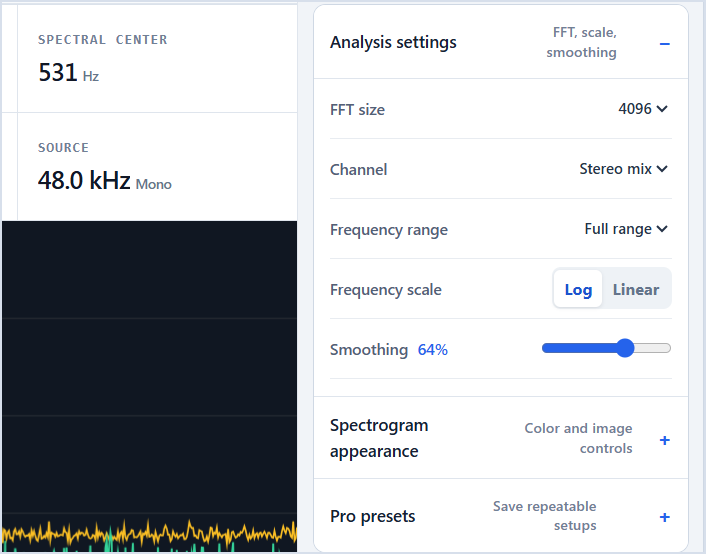
Begin at FFT 4096
Use the balanced default with the correct channel and keep the frequency range fixed.
- 02
Observe the main peak
Record the Peak frequency and Peak level before changing the transform size.

- 03
Check separation around nearby peaks
Increase FFT size if stable tones merge; reduce it if transient timing becomes too smeared.
- 04
Confirm the trade-off over time
Open Spectrogram and verify whether the chosen setting preserves the timing of the feature you care about.
Common questions
Does a higher FFT size always look better?
No. It improves frequency separation but reduces time precision and can make a live display feel less immediate.
How do I calculate frequency-bin width?
Divide the sample rate by FFT size. For 44,100 Hz and FFT 4096, the spacing is approximately 10.77 Hz.
Does FFT size change the audio?
No. It changes how the analyzer groups and displays the existing audio samples.
See the frequencies for yourself.
Upload a file, use the microphone, freeze any moment, and export the result.
Analyze audio