The highest representable frequency is half the sample rate, but real recordings also depend on anti-alias filters, source bandwidth, and any resampling in the signal path.
From samples to a frequency limit
Digital audio stores a sequence of amplitude measurements called samples. The sample rate tells you how many measurements are taken each second. A 48 kHz recording contains 48,000 samples per second; a 44.1 kHz recording contains 44,100.
The Nyquist frequency is half the sample rate. That places the theoretical upper limit at 24 kHz for 48 kHz audio and 22.05 kHz for 44.1 kHz audio. Frequencies above that limit cannot be represented as unique frequencies after sampling.
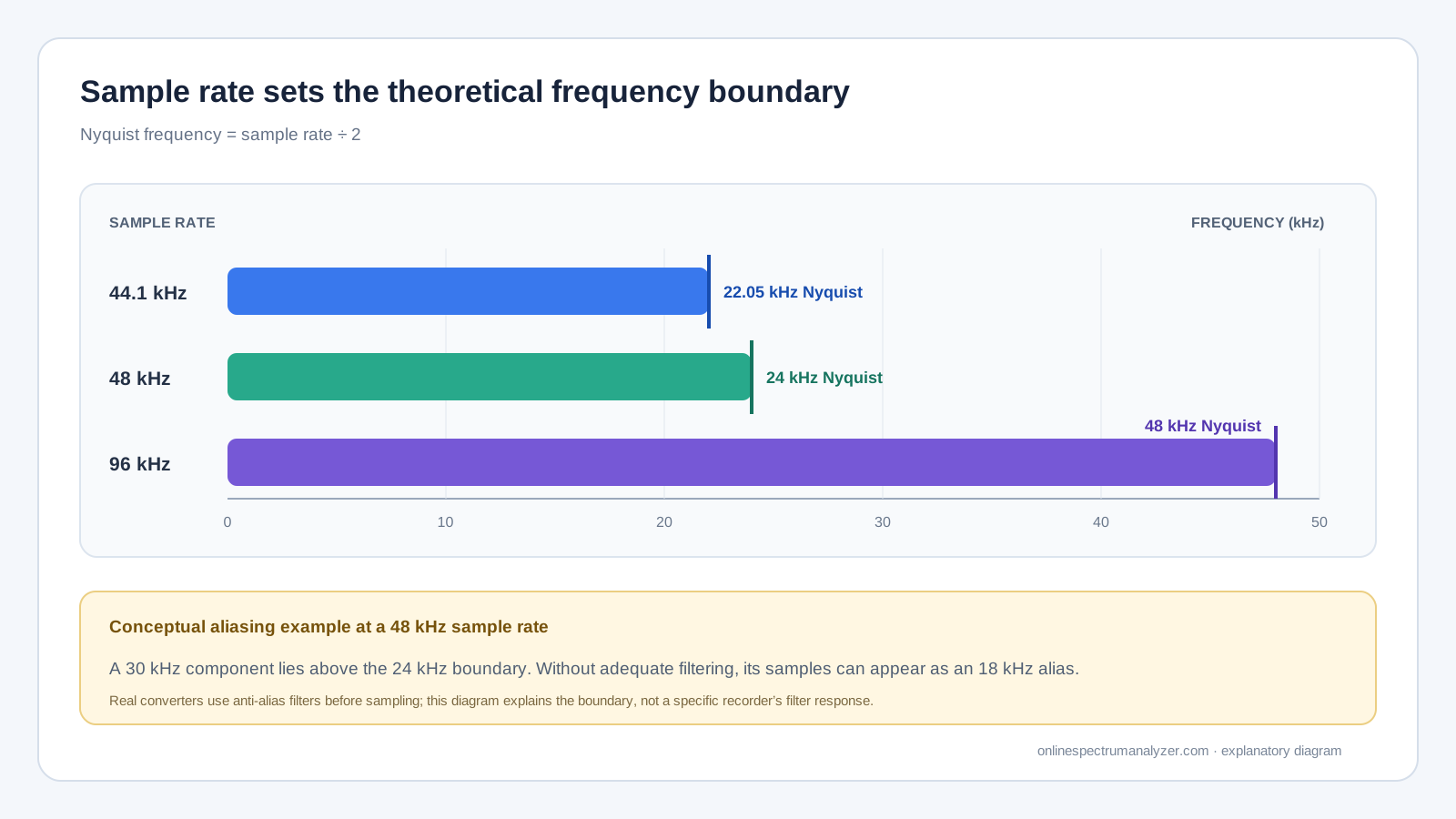
- 44.1 kHz sample rate → 22.05 kHz Nyquist frequency.
- 48 kHz sample rate → 24 kHz Nyquist frequency.
- 96 kHz sample rate → 48 kHz Nyquist frequency.
Why Nyquist is not the usable bandwidth
The theoretical limit is not a promise that a recording contains clean information all the way to that frequency. Recording equipment uses anti-alias filters to reduce energy above the usable band before sampling. Microphones, interfaces, codecs, and the original source may impose lower limits of their own.
A sharp cutoff near the top of a spectrum can therefore reflect filtering or encoding rather than missing analysis data. Lossy codecs may show a lower or changing cutoff, while speech devices and communication systems can intentionally preserve only the frequencies needed for intelligibility.
Recognize aliasing and resampling
Aliasing occurs when energy above the Nyquist frequency enters the sampled signal without adequate filtering. Instead of disappearing, it folds into lower frequencies and can create tones that were not present in the original source. Proper recording systems prevent most of this with anti-alias filtering.
Resampling converts audio from one sample rate to another. Good resampling applies filtering and interpolation so the audible result remains accurate. Poor conversion can introduce mirrored components, ringing, or an unexpected high-frequency cutoff. A spectrogram is useful because these artifacts may remain stable or track the original signal over time.
Choose a rate for the actual job
For listening and music delivery, 44.1 or 48 kHz covers the conventional audible range. Video and many browser or device audio pipelines commonly use 48 kHz. Higher rates can be useful during specialized recording, processing, measurement, or sound design, but they also increase file size and computation.
When comparing two files, confirm their sample rates before comparing the top end of their spectra. Keep the FFT settings consistent, and remember that frequency-bin spacing equals sample rate divided by FFT size. The same FFT size produces wider bins at a higher sample rate.
Common questions
Can a 44.1 kHz file contain 30 kHz audio?
No. Its Nyquist frequency is 22.05 kHz, so 30 kHz cannot be represented as a unique frequency in properly sampled 44.1 kHz audio.
Does 96 kHz automatically sound better than 48 kHz?
Not automatically. The audible result depends on the source, converters, processing, playback system, and listening conditions. Higher rates mainly extend bandwidth and change processing tradeoffs.
Why does the spectrum stop below the Nyquist frequency?
The source, microphone, anti-alias filter, codec, or resampling stage may limit the usable bandwidth before the theoretical Nyquist boundary.
See the frequencies for yourself.
Upload a file, use the microphone, freeze any moment, and export the result.
Analyze audio