Record a stable section, freeze the spectrum, read the peak, and verify that its multiples form a harmonic series before calling it the fundamental.
Prepare a useful signal
Choose a section where the target sound is isolated and steady. Background speech, room noise, reverb, and overlapping instruments can produce stronger peaks than the source you want. For microphone measurement, place the microphone consistently and avoid automatic gain changes when your device allows it.
Upload the file or start microphone input, then watch the Spectrum view. A logarithmic scale is easier for general sound; a focused bass or vocal range gives more horizontal space when you already know the approximate band.
Follow the complete analyzer workflow
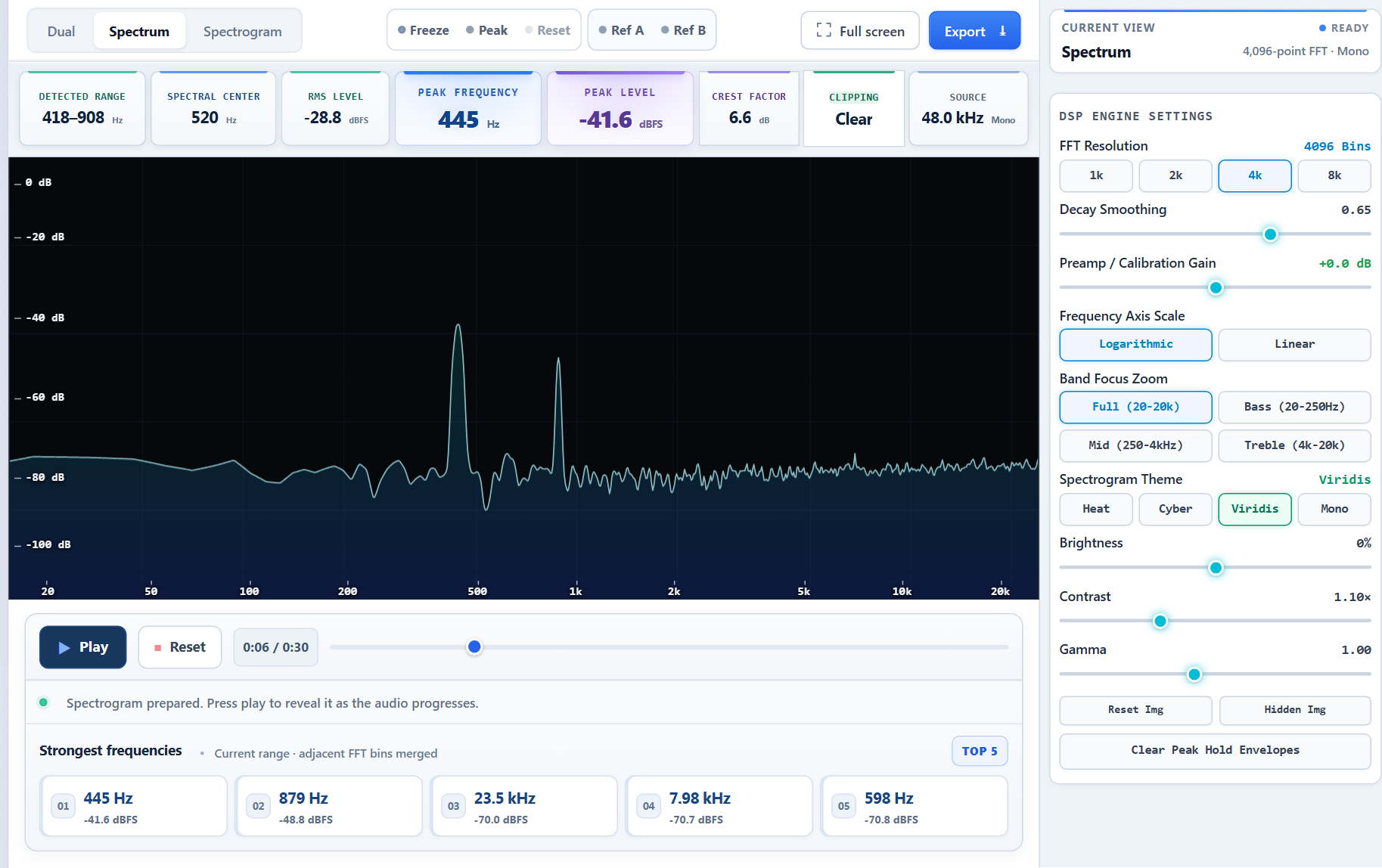
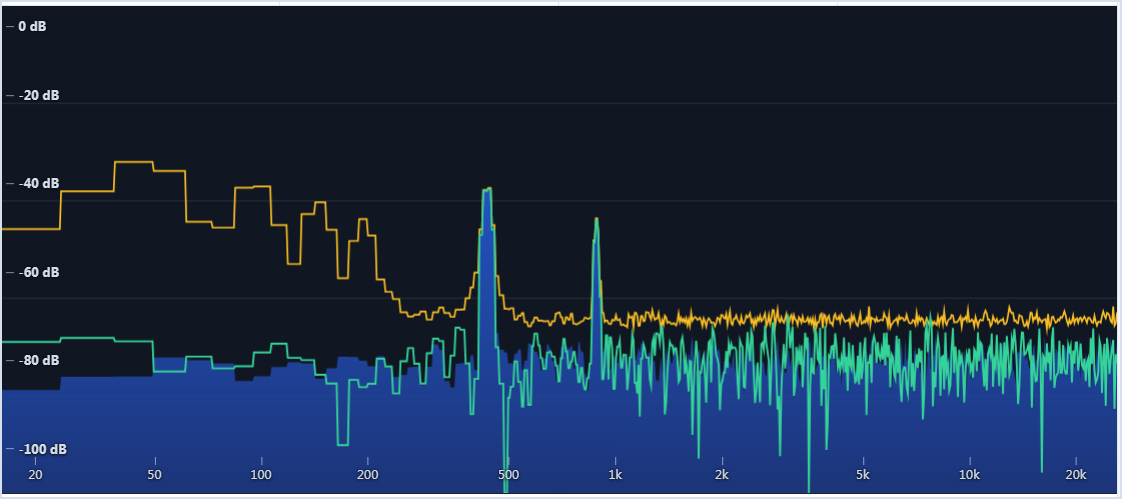
The screenshot below shows the result after a file is loaded and a stable moment is playing. The eight measurements and the Strongest frequencies list provide numerical checks alongside the trace. Use the same sequence each time so a different FFT size, channel, or playback moment is not mistaken for a change in the source.
- 01
Load the original recording
Select Upload audio file and choose the original file. Avoid re-encoding it before measurement.

- 02
Set the analysis view
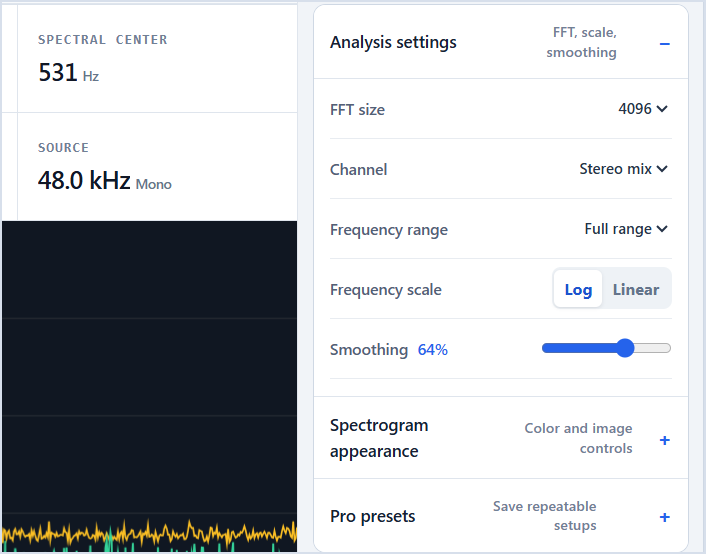
Open Spectrum, select the correct channel, and begin with FFT 4096, Log scale, and Full range.
- 03
Move to a stable passage
Play until the target sound is isolated and steady. Note the playback position so the same moment can be checked again.

- 04
Hold a representative trace
Use Peak Hold for a brief tone, or Freeze display when the live spectrum represents the passage clearly.

- 05
Read the measured peak
Read Peak frequency and Peak level, then keep the detected range and source properties visible as context.

- 06
Confirm the harmonic pattern
Inspect the trace for evenly spaced multiples. The tallest component can be a harmonic rather than the fundamental.
- 07
Export reproducible evidence
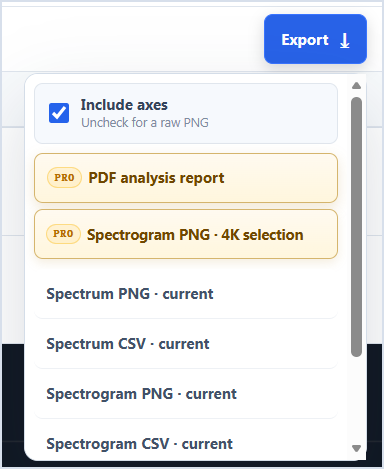
Record the playback time, FFT size, and channel, then export a Spectrum PNG or CSV for the result.
Measure the peak
Play the stable portion and enable Peak Hold if the tone is brief. Freeze the display when the trace represents the sound clearly. Move the cursor across the main peak to read frequency and dBFS level, and note the peak-frequency metric as a second check.
Repeat the measurement over several frames. A natural source may drift slightly, while vibrato deliberately moves the pitch. Reporting a range can be more honest than reporting a single over-precise value.
Confirm the fundamental
The strongest peak may be a harmonic. Look for a sequence whose spacing matches a lower base frequency. Peaks near 400, 600, and 800 Hz may imply a 200 Hz fundamental even when the 200 Hz peak is weaker.
For musical notes, compare the result with a pitch-frequency table, but allow for tuning standards, performance variation, and recording speed. For machinery, repeating sidebands may be more informative than one central peak.
Export evidence, not just a number
Export a current Spectrum PNG when you need a readable visual record. Export CSV when you need to sort peaks, calculate averages, compare multiple tests, or document the exact bins used by the analyzer.
Write down the sample rate, FFT size, channel selection, frequency scale, and playback position. Those settings make the result reproducible and explain small differences between tools.
Common questions
Can a phone microphone measure frequency?
Usually yes for ordinary audible tones, but microphone response and automatic processing affect level accuracy, especially at very low and very high frequencies.
Why does the measured frequency move?
The source may drift or contain vibrato, noise may compete with the tone, or the FFT bins may alternate around a frequency between them.
Is peak frequency the same as musical pitch?
Not always. Perceived pitch depends on the harmonic pattern, and the strongest spectral component can be a harmonic rather than the fundamental.
See the frequencies for yourself.
Upload a file, use the microphone, freeze any moment, and export the result.
Analyze audio