Use Integrated LUFS to describe average programme loudness and True Peak to protect reconstructed peak headroom; neither measurement replaces the other.
Why peak level is not loudness
A sample-peak meter reports the highest stored sample value, but human perception does not judge loudness from one sample. Two files can reach the same sample peak and still sound very different because their average energy, frequency balance, dynamics, and duration are different. That is why delivery checks need more than a peak meter.
LUFS—Loudness Units relative to Full Scale—applies frequency weighting and time integration to estimate programme loudness in digital audio. A change of 1 LU represents a 1 dB change in the measured loudness domain. The value remains below zero for ordinary programme material because digital full scale is the upper reference.
- Sample peak: the highest numerical sample in the file, expressed in dBFS.
- True Peak: an estimate of the highest reconstructed waveform peak, expressed in dBTP.
- Integrated LUFS: gated loudness across the measured programme.
- Momentary and Short-term loudness: moving views of how loudness changes over time.
Read Integrated, Momentary, Short-term, and LRA together
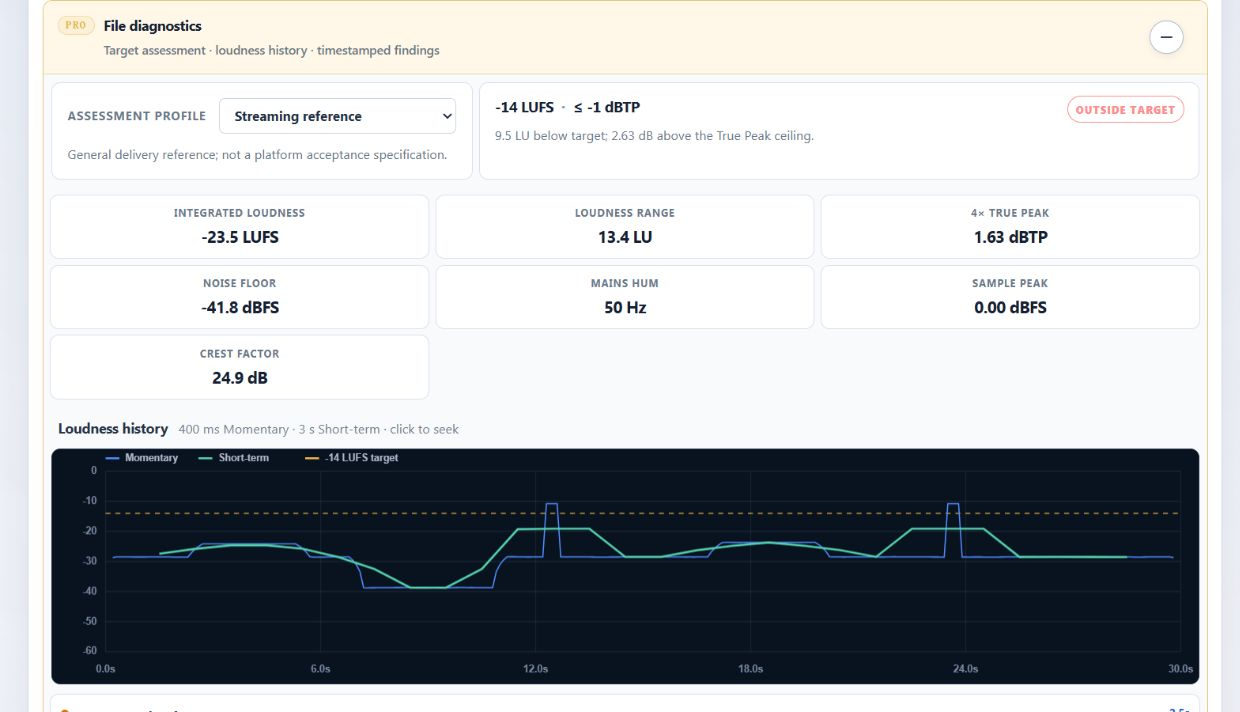
Integrated loudness summarizes the analysed programme after gating very quiet material according to the measurement method. It is the main number used when comparing a complete mix or episode with a delivery reference. It should be measured across the whole relevant programme, not from a random five-second passage.
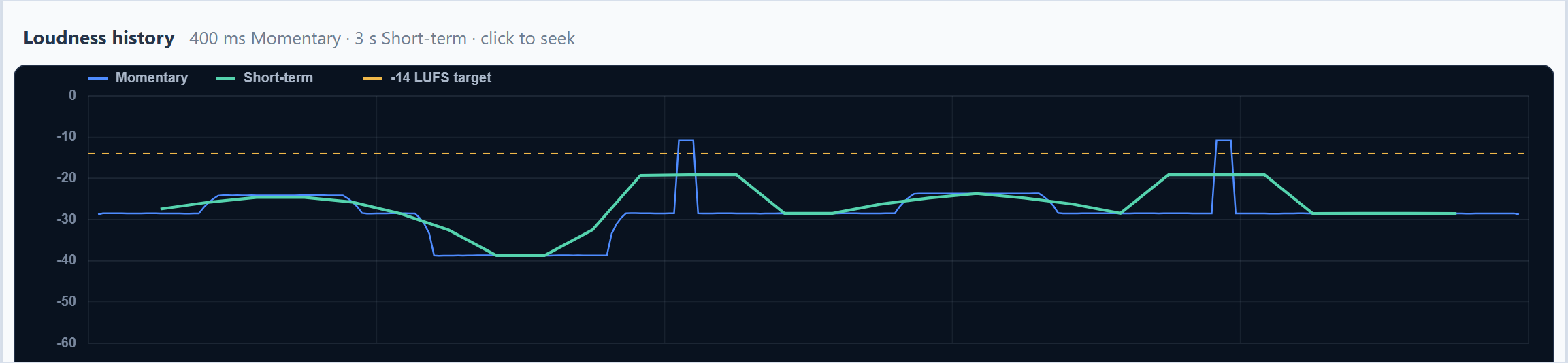
Momentary loudness uses a short window—commonly 400 ms—to expose brief changes. Short-term loudness uses a longer three-second window, making dialogue sections and musical phrases easier to compare. Loudness Range, reported in LU, describes the distribution of short-term loudness after gating; it is useful for understanding variation, but it is not simply the difference between the quietest and loudest samples.
Why True Peak can exceed sample peak
Digital samples are points on a waveform, not the continuous waveform itself. During digital-to-analogue conversion, resampling, or lossy encoding, the reconstructed curve between samples can rise above the highest stored sample. These inter-sample peaks explain why a file that never exceeds 0 dBFS at its samples can still produce a True Peak above 0 dBTP.
A True Peak meter oversamples or reconstructs the signal to estimate those between-sample maxima. More headroom reduces the chance that later encoding, conversion, or playback stages will clip. The appropriate ceiling depends on the delivery specification, codec, and workflow; a generic preset should be treated as a reference until the actual destination specification is confirmed.
Use targets without mistaking them for certification
A target assessment answers a practical question: how far is this file from a selected loudness reference, and how much True Peak headroom remains? It does not prove that a platform will accept the file. Services can change playback normalization, analyse albums differently, or impose programme-specific requirements that a general-purpose browser tool cannot certify.
For a repeatable check, analyse the complete final file, choose the reference that matches the intended use, inspect both the summary and the timeline, and listen to the passages that create the largest excursions. Keep the method note with the result so another person can understand exactly what was measured.
- 01
Load the final delivery file
Use the encoded file that will actually be delivered, then let the complete-file analysis finish.

- 02
Read loudness and True Peak separately
Compare Integrated LUFS with the selected reference, then check the True Peak ceiling as a separate constraint.
- 03
Inspect the passages behind the result
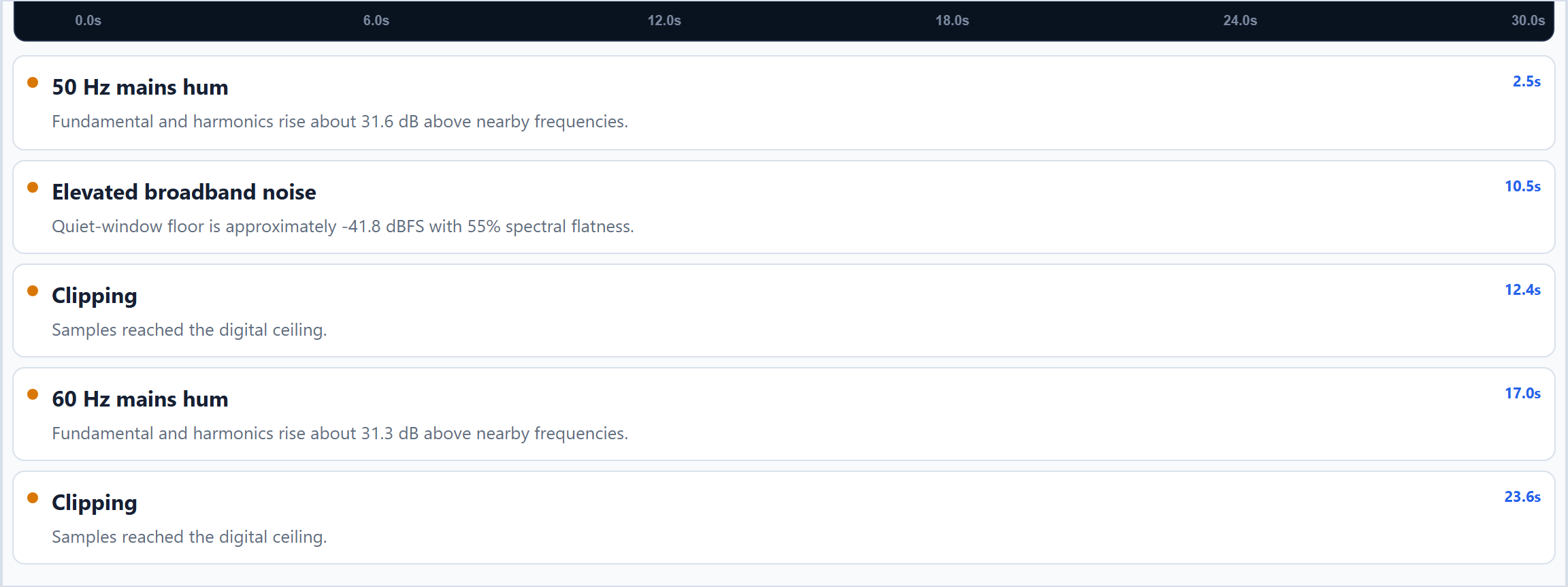
Use the timeline and timestamped findings to locate local jumps, weak sections, or peak events instead of relying on the summary alone.
- 04
Export the evidence with its limits
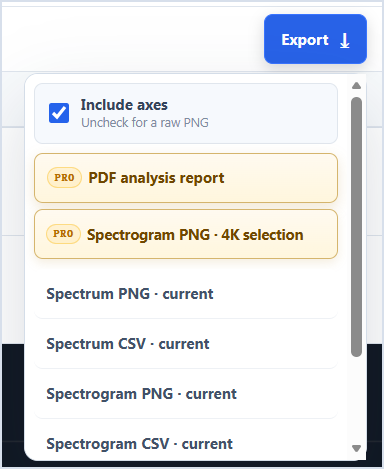
Review the PDF method note and confirm the destination's current specification before calling a result compliant.
Common questions
Is LUFS the same as dBFS?
No. dBFS describes digital signal level relative to full scale. LUFS applies frequency weighting, time integration, and gating to estimate programme loudness.
Can True Peak be higher than 0 dBTP when sample peak is 0 dBFS?
Yes. Reconstruction between stored samples can produce an inter-sample peak above the highest sample value.
Does matching -14 LUFS guarantee correct streaming playback?
No. -14 LUFS is a commonly used reference, not a universal acceptance rule. Platforms and content types can use different normalization and delivery policies.
Is the browser measurement a certified compliance result?
No. It is an engineering diagnostic. Use a calibrated, certified meter when a contract, broadcaster, or regulator requires formal compliance.
See the frequencies for yourself.
Upload a file, use the microphone, freeze any moment, and export the result.
Analyze audio